Heraldry
The Arms
Granted by the Order to itself, there being nobody else to ask
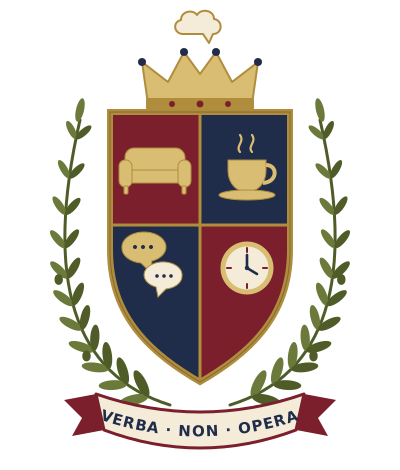
Every respectable society needs a coat of arms, and the Order, having very little else, takes its arms seriously. They were devised over several sessions, during which the design was discussed in great detail and changed almost not at all. Each element has a meaning, and some have two.
The Blazon
In the formal language of heraldry, the arms are described as follows:
Quarterly gules and azure, a cross of the field fimbriated Or. In the first quarter a sofa Or; in the second a teacup steaming upon its saucer Or; in the third two speech bubbles, the one Or, the other argent; in the fourth a clock argent rimmed Or. The shield ensigned with a crown Or, surmounted by a small cloud of speech argent. On either side a branch of olive vert, fructed. Beneath, upon a ribbon argent edged gules, the motto Verba, non opera.
For those who do not speak heraldry: the shield is divided into four, red and blue, with a thin line of gold between the quarters. Gold, red, blue and white are the colours of the Order and may be worn by members on any occasion that does not require anything to be done.
The Four Quarters
I. The Sofa
The sofa stands first because it came first. It represents the seat of all deliberation and the foundation of the Order. It is drawn empty, not because nobody is sitting on it, but because the herald could not decide who should be.
II. The Teacup
The teacup signifies hospitality and also delay, since no serious conversation can begin until everyone has a cup, and no cup can be poured until the conversation about who takes sugar has been concluded. The steam rising from it shows that the tea is still hot, which in practice it rarely is.
III. The Speech Bubbles
Two bubbles, overlapping, represent the conversation itself. That one is gold and the other white is held to show that every exchange has two sides, one of them more valuable than the other. Members disagree about which is which, and this disagreement is itself considered a proper use of the arms.
IV. The Clock
The clock stands for time, and in particular for time well spent on something other than what it was meant for. Its hands do not move. The members are agreed that this is a deliberate symbol of the Order's relationship with schedules, and not, as has been unkindly suggested, because nobody remembered to wind it.
The Crown and the Cloud
The crown is a claim to dignity that the Order has not earned and does not intend to. Above it floats a small cloud of speech, showing that even the highest authority of the Order is, in the end, only talking.
The Olive Branches
The olive is the emblem of peace. The Order has never had an enemy, mainly because it has never done anything that might provoke one. The branches also recall the olives that are sometimes served at sessions and were, on one occasion, the subject of a conversation lasting the better part of an afternoon.
The Motto
Verba, non opera — “Words, not deeds.” It is the reverse of a familiar saying, and the founders chose it after considering many alternatives, which they discussed at such length that they never got around to adopting any of them. The motto is spoken aloud only at the opening of a session, and only once, since saying it twice would be repetitive, and repetition is very nearly a form of work.